
Cursive Loop Letters e, l, h, f, k, b — Grade 2
Grade 2 practice for the loop stroke family (e, l, h, f, k, b): trace and copy the set, then six words that use it. Free printable PDF on one page.
About this worksheet
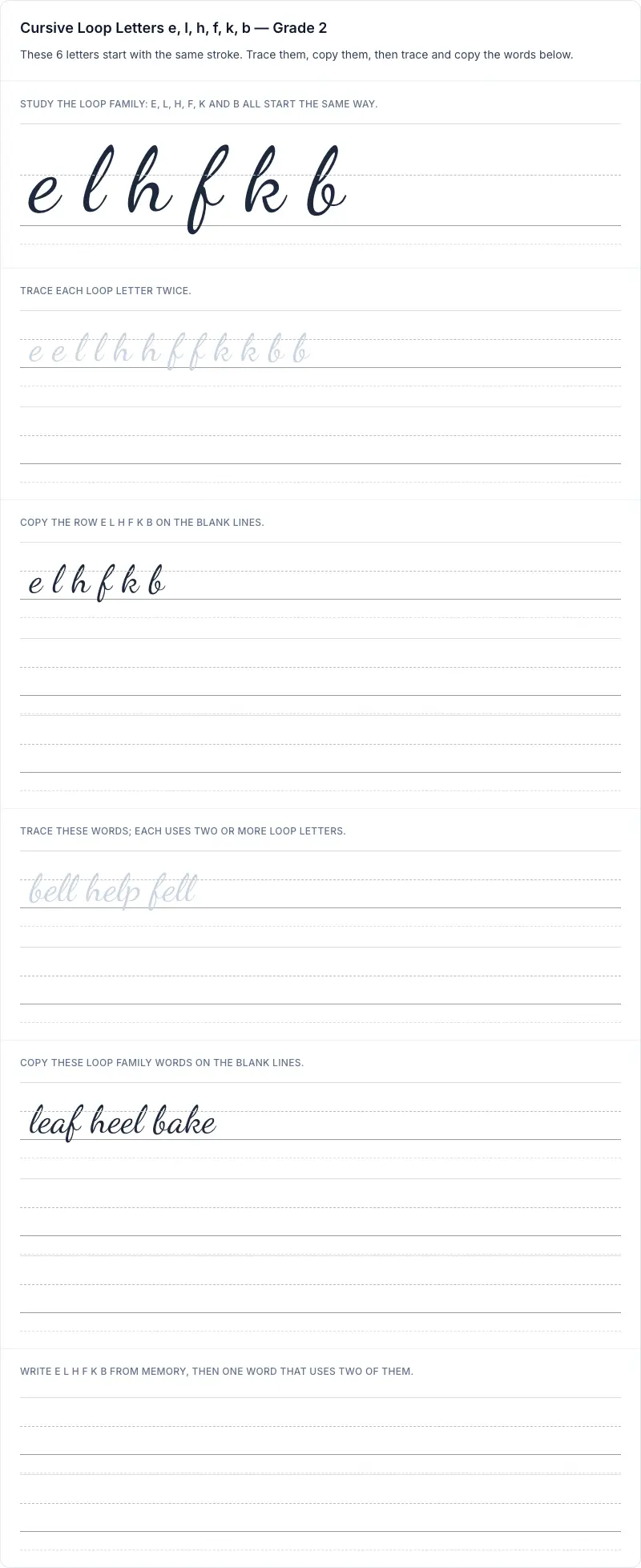
This grade 2 sheet covers the second lowercase stroke family, e, l, h, f, k and b, in 6 blocks and 8 guided lines. The 6 letters are shown together as a model, traced twice each, and copied as a row; then 6 words (bell, help, fell, leaf, heel and bake) are traced and copied, and every one of them contains at least two of the loop letters. Between them the loop family rows use 8 of the 26 lowercase letters, 5 of them tall (b, f, h, k, l) and 2 that drop below the baseline (f, p).
Cursive Loop Letters e, l, h, f, k, b — Grade 2
These 6 letters start with the same stroke. Trace them, copy them, then trace and copy the words below.
Study the loop family: e, l, h, f, k and b all start the same way.
Trace each loop letter twice.
Copy the row e l h f k b on the blank lines.
Trace these words; each uses two or more loop letters.
Copy these loop family words on the blank lines.
Write e l h f k b from memory, then one word that uses two of them.
How to form these letters
- e: Undercurve to the midline, loop back over the stroke you just made, and swing down to the baseline exit.
- l: A tall loop to the topline, straight back down through the loop to the baseline, and out with an undercurve.
- h, f, k and b start with the same loop stroke as e and l; once those two are steady, the rest of the family usually comes in a fraction of the time.
See every letter at once on the cursive alphabet chart, uppercase and lowercase, in the same cursive face.
What the sheet asks the hand to do
Cursive Loop Letters e, l, h, f, k, b prints six blocks onto one side, with eight guided lines. One of a model to study, two of tracing, two of copying and one of free writing. The order is a model to look at, a traced row where the shape is already there, a copied row where it is not and a blank block with nothing printed at all, so the support comes away one step at a time rather than all at once.
The words on Cursive Loop Letters e, l, h, f, k, b are bell, help, fell, leaf, heel and bake: six distinct words, averaging 4.0 letters, the longest "bell" at 4 against a grade 2 limit of 8. Word length is the number to check before printing: a handwriting sheet that makes a student decode a word first is testing two things and reporting one.
Each block carries its own instruction rather than one set of directions at the top — the first reads “Study the loop family: e, l, h, f, k and b all start the same way.”, the last “Write e l h f k b from memory, then one word that uses two of them.”. That is what lets the sheet be handed to a student who is working alone.
The text on the page
The text on Cursive Loop Letters e, l, h, f, k, b runs to 6 words, averaging 4.0 letters each, with "bell" the longest of them. That is the number that decides whether a sheet is a warm-up or a session: at this stage a child's hand tires before their attention does, and a page of long words tires it faster than a page of many short ones.
Between them the rows on Cursive Loop Letters e, l, h, f, k, b use eight of the twenty-six lowercase letters — a, b, e, f, h, k, l and p. Five of them are tall letters (b, f, h, k, l), which is what makes the ruled height on this sheet matter, and two drop below the baseline (f, p), so the descender space is in use too.
Where this one sits
Cursive Loop Letters e, l, h, f, k, b is one of 31 Lowercase Letters sheets here and one of sixteen written for grade 2. It is letter repetition work, and it suits grade 2 and grade 3.
The closest things to Cursive Loop Letters e, l, h, f, k, b are Cursive Letter z Worksheet — Trace and Practice (grade 1) and Cursive Letter a Worksheet — Trace and Practice (grade 1). Cursive is one of the few subjects where doing the next sheet the same day is usually wrong — the hand needs the gap more than the head does — so those are the ones for tomorrow rather than for the rest of this session.
Notes for the grown-up
- The second stroke family is e, l, h, f, k and b. Have the student say the shared opening movement out loud on the first row; the point of a family sheet is that one movement is reused 6 times.
- The words bell, help, fell, leaf, heel and bake were chosen because each contains at least two of the family letters, so a word that goes wrong usually goes wrong on the same stroke twice. Fix the stroke, not the word.
- l, h, f, k and b must reach the topline, and f must drop below the baseline; check heights on the copy row before moving to the words.
Practice this next
More from lowercase letters and grade 2.
Cursive Mixed Letters r, s, j, p — Grade 2
Grade 2 practice for the mixed stroke family (r, s, j, p): trace and copy the set, then six words that use it. Free printable PDF on one page.
Cursive Oval Letters a, c, d, o, g, q — Grade 2
Grade 2 practice for the oval stroke family (a, c, d, o, g, q): trace and copy the set, then six words that use it. Free printable PDF on one page.
Cursive Slant Letters n, m, v, x, y, z — Grade 2
Grade 2 practice for the slant stroke family (n, m, v, x, y, z): trace and copy the set, then six words that use it. Free printable PDF on one page.
Cursive Undercurve Letters i, t, u, w — Grade 2
Grade 2 practice for the undercurve stroke family (i, t, u, w): trace and copy the set, then six words that use it. Free printable PDF on one page.
Cursive Letter p Worksheet — Trace and Practice
Six focused exercises guide Grade 1 students through tracing and copying cursive lowercase p, emphasizing the descender loop and connecting exit stroke.
Cursive Letter j Worksheet — Trace and Practice
Grade 1 cursive worksheet focused on lowercase j. Students trace and copy the letter, then practice with real words such as jar, jet, and jog.