
Cursive Copywork: Gettysburg Address, opening — Grade 6
Grade 6 cursive copywork: 54 words from Gettysburg Address by Abraham Lincoln (1863), a line per ruled row, then blank lines. Public domain text.
About this worksheet
This sheet copies 54 words from Gettysburg Address by Abraham Lincoln (1863), beginning "Four score and seven years ago…". "Gettysburg Address, opening" is split into 6 ruled lines, each copied once, followed by 2 blank lines for the student's own writing, 8 guided lines in all. As a work of the United States government, Gettysburg Address is in the public domain. Between them the lines of "Gettysburg Address, opening" use 22 of the 26 lowercase letters, 6 of them tall (b, d, f, h, l, t) and 5 that drop below the baseline (f, g, p, q, y).
Source: Gettysburg Address by Abraham Lincoln (1863). Bliss copy, opening two sentences. A speech by the President of the United States; US federal government work, public domain.
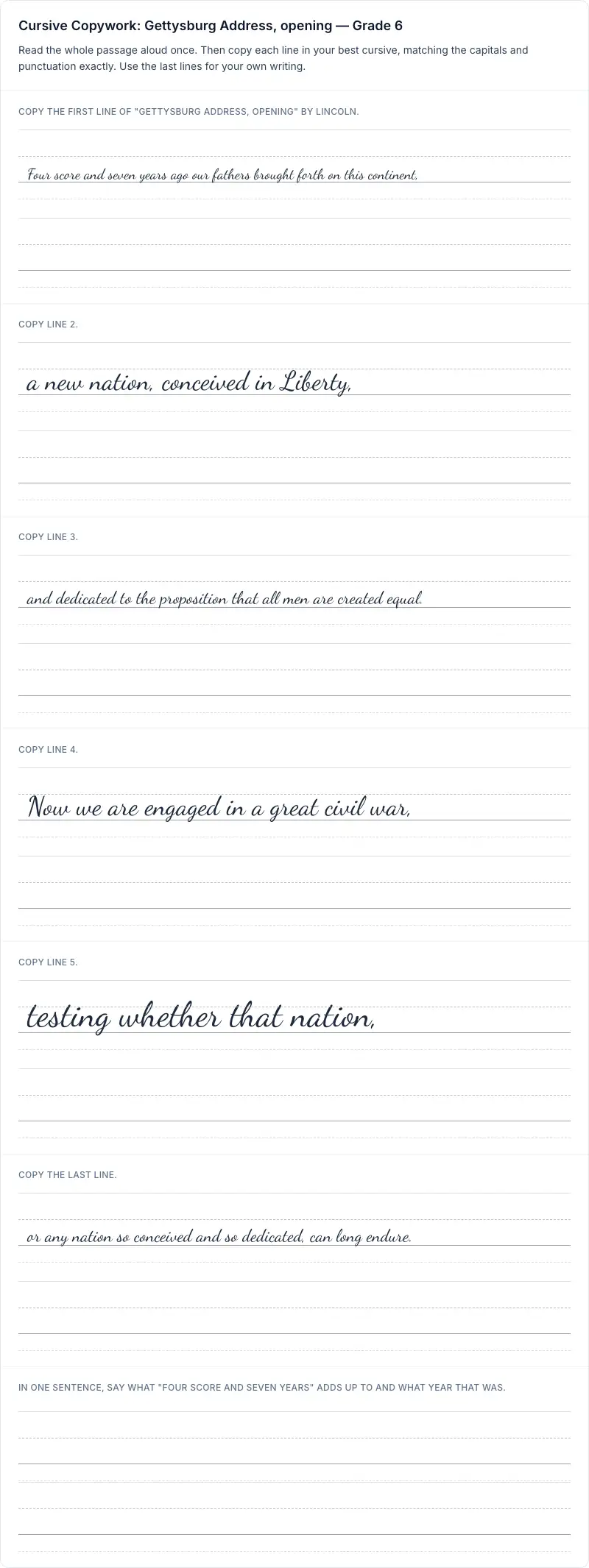
Cursive Copywork: Gettysburg Address, opening — Grade 6
Read the whole passage aloud once. Then copy each line in your best cursive, matching the capitals and punctuation exactly. Use the last lines for your own writing.
Copy the first line of "Gettysburg Address, opening" by Lincoln.
Copy line 2.
Copy line 3.
Copy line 4.
Copy line 5.
Copy the last line.
In one sentence, say what "four score and seven years" adds up to and what year that was.
How to form these letters
- The lowercase letter o appears 22 times here, as in "Four". Undercurve to the midline, close the oval, and exit from the top of the letter with a short bridge stroke.
- The lowercase letter r appears 17 times here, as in "Four". Undercurve to the midline, a tiny shoulder to the right, then a short downstroke and an undercurve exit.
- The lowercase letter s appears 9 times here, as in "score". Undercurve to the midline, curve back down to the left, close against the stroke at the baseline and exit forward.
What the sheet asks the hand to do
Cursive Copywork: Gettysburg Address, opening is seven blocks and eight guided lines. Six of copying and one of free writing. The order is a copied row written from a printed model and a blank block with nothing printed at all: nothing on this sheet is traced, so the student writes from a printed model from the first row.
The words on Cursive Copywork: Gettysburg Address, opening are Four, score, and, seven, years, ago, our, fathers, brought, forth, on, this, continent and a, and 29 more: 43 distinct words, averaging 4.6 letters, the longest "proposition" at 11 against a grade 6 limit of 14. Word length is the number to check before printing: a handwriting sheet that makes a student decode a word first is testing two things and reporting one.
Each block carries its own instruction rather than one set of directions at the top — the first reads “Copy the first line of "Gettysburg Address, opening" by Lincoln.”, the last “In one sentence, say what "four score and seven years" adds up to and what year that was.”. That is what lets the sheet be handed to a student who is working alone.
The text on the page
The text on Cursive Copywork: Gettysburg Address, opening runs to 54 words over six rows, averaging 4.6 letters each, with "proposition" the longest of them. That is the number that decides whether a sheet is a warm-up or a session: at this stage a child's hand tires before their attention does, and a page of long words tires it faster than a page of many short ones.
Between them the rows on Cursive Copywork: Gettysburg Address, opening use twenty-two of the twenty-six lowercase letters — a, b, c, d, e, f, g, h, i, l, m, n, o, p, q, r, s, t, u, v, w and y. Six of them are tall letters (b, d, f, h, l, t), which is what makes the ruled height on this sheet matter, and five drop below the baseline (f, g, p, q, y), so the descender space is in use too.
Where this one sits
Cursive Copywork: Gettysburg Address, opening is one of twenty-one Paragraph Practice sheets here and one of twelve written for grade 6. It is paragraph copying work, and it suits grade 6.
The closest things to Cursive Copywork: Gettysburg Address, opening are Cursive Paragraph Practice: Story Passage (grade 4) and Cursive Guided Writing: A Thank-You Note (grade 5). Cursive is one of the few subjects where doing the next sheet the same day is usually wrong — the hand needs the gap more than the head does — so those are the ones for tomorrow rather than for the rest of this session.
Notes for the grown-up
- This passage is 54 words in 6 ruled lines. Have the student read it aloud first so the hand is not decoding and forming letters at the same time.
- The line breaks were made at clause boundaries so each row is a complete thought; a student who stops mid-row has lost the sense as well as the stroke. Capitals and punctuation are quoted exactly from Gettysburg Address.
- Ready to move on when the line "Four score and seven years ago our fathers brought forth on this continent," is copied with no pencil lift inside a word and the slant held from the first word to the last.
Practice this next
More from paragraph practice and grade 6.
Cursive Copywork: The Hare and the Tortoise — Grade 6
Grade 6 cursive copywork: 42 words from The Hare and the Tortoise by Aesop (1867), a line per ruled row, then blank lines. Public domain text.
Cursive Copywork: The Declaration of Independence — Grade 6
Grade 6 cursive copywork: 35 words from The Declaration of Independence by Thomas Jefferson (1776), a line per ruled row, then blank lines. Public domain text.
Cursive Copywork: The New Colossus — Grade 6
Grade 6 cursive copywork: 35 words from The New Colossus by Emma Lazarus (1883), a line per ruled row, then blank lines. Public domain text, free printable PDF.
Cursive Copywork: Gettysburg Address, unfinished work — Grade 6
Grade 6 cursive copywork: 47 words from Gettysburg Address by Abraham Lincoln (1863), a line per ruled row, then blank lines. Public domain text.
Cursive Copywork: Paul Revere's Ride — Grade 6
Grade 6 cursive copywork: 34 words from Paul Revere's Ride by Henry Wadsworth Longfellow (1860), a line per ruled row, then blank lines. Public domain text.
Cursive Copywork: A Psalm of Life — Grade 6
Grade 6 cursive copywork: 24 words from A Psalm of Life by Henry Wadsworth Longfellow (1838), a line per ruled row, then blank lines. Public domain text.